
Simple Bowl
Kyiv Region, Dybyntsi Village. Unknown maker.
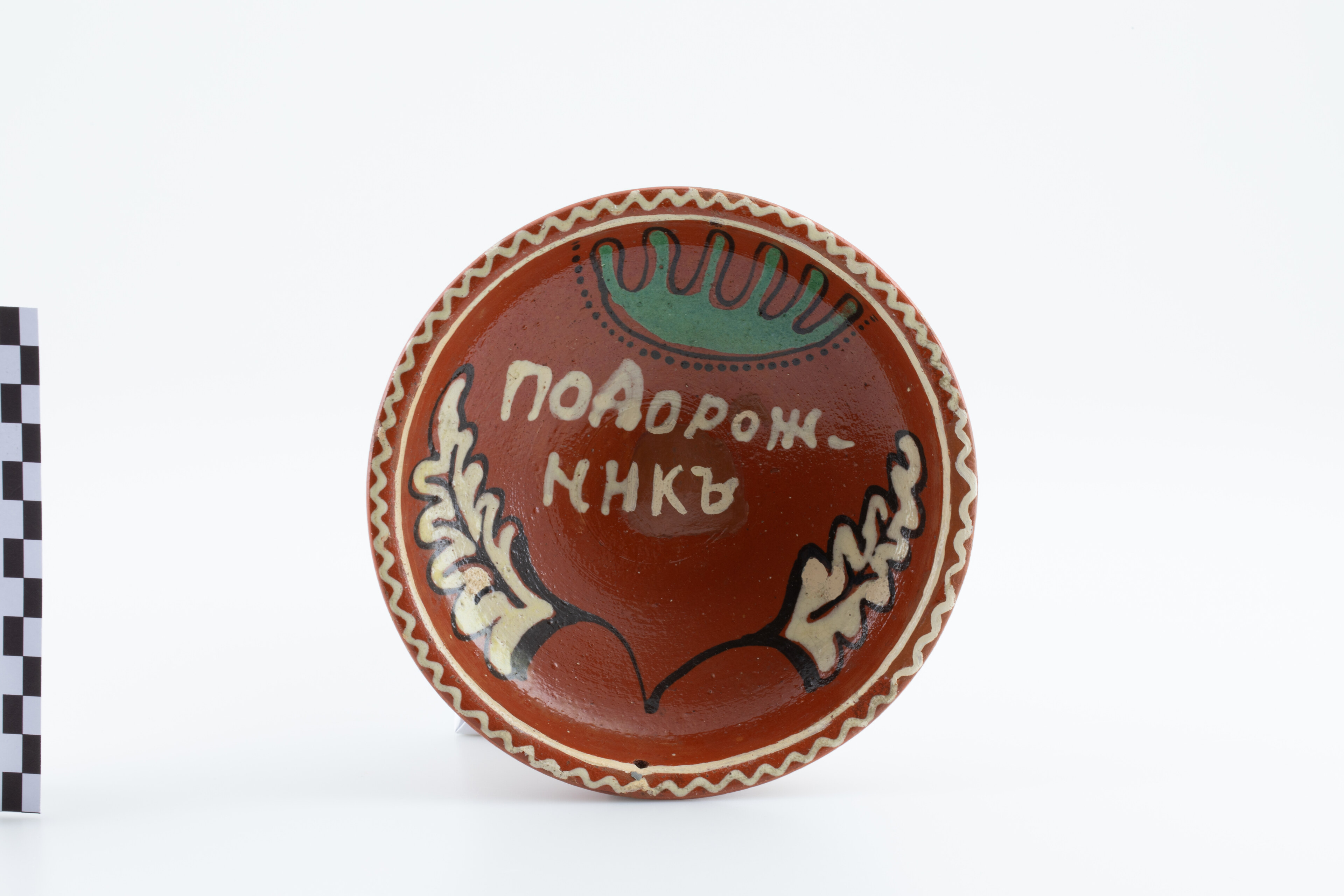
The bowl has a brown ground. The centre of the interior is decorated with two white leaves, between which is an inscription reading “ПОДОРОЖНИ…” (“PODOROZHNY…”), with a stylised green leaf above. The narrow, clearly defined rim is decorated with a white wavy line. The exterior is unglazed.
The village of Dybyntsi has long been renowned for its pottery. As early as the 18th century, a potters’ guild bringing together skilled craftsmen from the surrounding settlements was centred in the area. From 1807 to 1828, a faience factory owned by the Branicki counts operated here, employing more than one hundred local potters. From the second half of the 19th century, Dybyntsi pottery and refractory bricks were marketed well beyond the region. During this period, production of the principal types of pottery increased, including bowls, pitchers, pots, stove tiles, and mugs.
The success of local craftsmen was largely due to abundant deposits of high-quality clay, which enabled them to produce well-made vessels with elaborate forms and ornamentation. At the beginning of the 20th century, the artistic ceramics of Dybyntsi potters ranked among the leading pottery traditions of Kyiv Governorate. In 1913, the work of local craftsmen, including Kalenyk Masiuk, Yelysei Protsenko, Borys Breus, Kyrylo Rodak, and Zosym and Yatrop Masiuk, was recognised at All-Russian handicraft exhibitions in Kyiv and St Petersburg. In the same year, a travelling pottery training workshop was established in Dybyntsi by decision of the Third Kyiv Provincial Zemstvo Assembly. It operated in 1914–1915 under the direction of K. Masiuk. In 1931–1933, the Ceramic vocational school operated in the village, where artistic disciplines were taught by K. Masiuk and A. Rodak.
Provenance: From the museum collection, acquired before the Second World War.
Kyiv Region, Dybyntsi Village. Late 19th–Early 20th Century. Unknown maker.
The bowl has a brown ground. The centre of the interior is decorated with two white leaves, between which is an inscription reading “ПОДОРОЖНИ…” (“PODOROZHNY…”), with a stylised green leaf above. The narrow, clearly defined rim is decorated with a white wavy line. The exterior is unglazed.
The village of Dybyntsi has long been renowned for its pottery. As early as the 18th century, a potters’ guild bringing together skilled craftsmen from the surrounding settlements was centred in the area. From 1807 to 1828, a faience factory owned by the Branicki counts operated here, employing more than one hundred local potters. From the second half of the 19th century, Dybyntsi pottery and refractory bricks were marketed well beyond the region. During this period, production of the principal types of pottery increased, including bowls, pitchers, pots, stove tiles, and mugs.
The success of local craftsmen was largely due to abundant deposits of high-quality clay, which enabled them to produce well-made vessels with elaborate forms and ornamentation. At the beginning of the 20th century, the artistic ceramics of Dybyntsi potters ranked among the leading pottery traditions of Kyiv Governorate. In 1913, the work of local craftsmen, including Kalenyk Masiuk, Yelysei Protsenko, Borys Breus, Kyrylo Rodak, and Zosym and Yatrop Masiuk, was recognised at All-Russian handicraft exhibitions in Kyiv and St Petersburg. In the same year, a travelling pottery training workshop was established in Dybyntsi by decision of the Third Kyiv Provincial Zemstvo Assembly. It operated in 1914–1915 under the direction of K. Masiuk. In 1931–1933, the Ceramic vocational school operated in the village, where artistic disciplines were taught by K. Masiuk and A. Rodak.
Provenance: From the museum collection, acquired before the Second World War.
Passport of exhibit
- Inventory marks: ПКМВК 9903 Кс 737
- Author (manufacturer): Unknown master
- Material: Clay, Engobes, Glaze
- Technique: Painting, Throwing wheel, Glazing, baking
- Dating: Late 19th–Early 20th Century
- Size: Rim diameter 16 cm, base diameter 8 cm, height 4 cm