
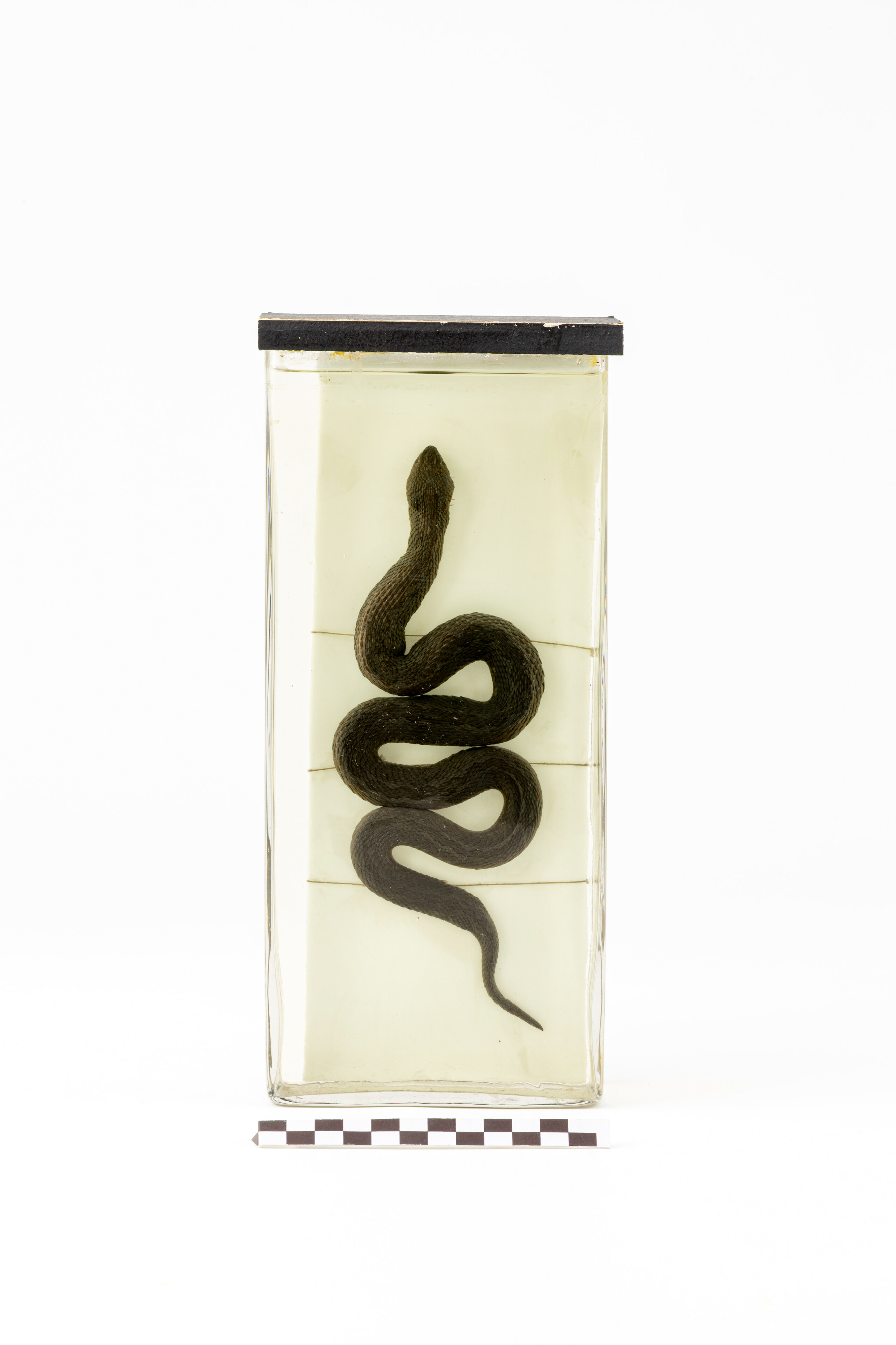
Wet Specimen. Eastern Steppe Viper.
The wet specimen represents an Eastern Steppe Viper, a venomous snake of the viper family (Viperidae) distributed in steppe and forest-steppe regions of Eastern Europe and Central Asia. The specimen is preserved in a conserving solution and placed in a hermetically sealed glass vessel, ensuring long-term preservation of the animal’s anatomical features.
The snake has an elongated, relatively robust body covered with small scales. The head is distinctly demarcated from the body and triangular in shape, with the characteristic venomous fangs of vipers. The dorsal coloration ranges from greyish-brown to light brown, with a dark zigzag stripe running along the spine, a characteristic feature of the species. The ventral surface is lighter, with individual variations in coloration.
The Eastern Steppe Viper is a characteristic inhabitant of steppe ecosystems. It feeds mainly on small rodents, lizards, and large insects, playing an important role in regulating animal populations within natural biocoenoses. The species is viviparous, and its distribution is closely associated with the preservation of natural steppe landscapes.
The wet specimen was prepared for educational and scientific purposes by fixing the tissues with specialised preserving substances and subsequently storing the animal in a liquid medium. This method of preservation makes it possible to study the external morphology, body proportions, and structural features of the animal.
The specimen was collected during an expedition to the Karlivka Steppe near the village of Lypianka in 1948.
Provenance: Prepared by the museum taxidermist.
Passport of exhibit
- Inventory marks: ПКМВК 5608 П 1228
- Material: Glass, Wet Specimen Preserved in Alcohol
- Technique: Wet Preservation
- Dating: 1948
- Size: 30,5 х 13 х 4,5 сm