
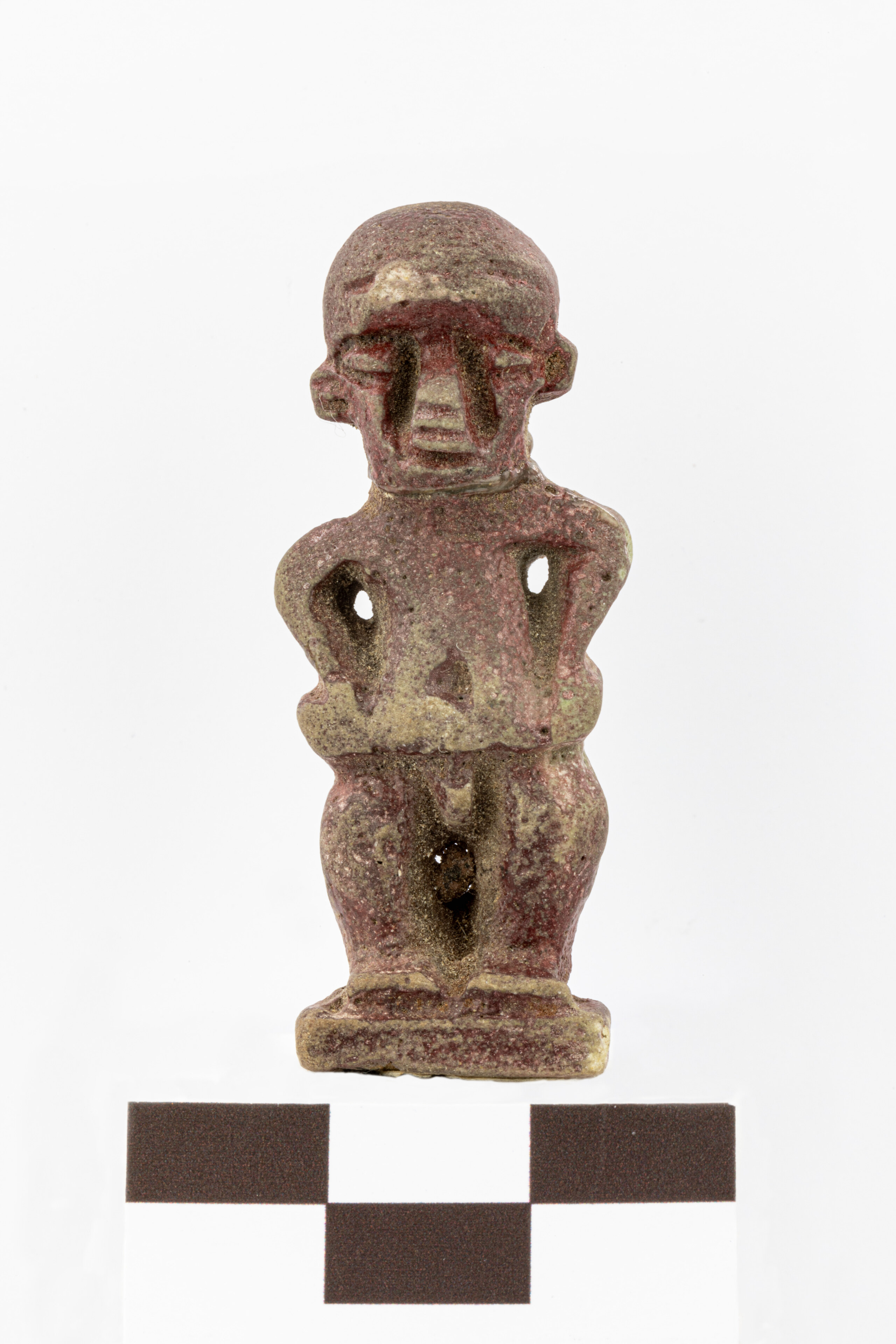
Pataikos Amulet
Ancient Egypt.
An amulet depicting the deity Pataikos, made of faience. The figurine represents a nude, deformed dwarf with a disproportionately large head, short limbs, and accentuated facial features. The figure is shown frontally, with the arms bent at the chest. The surface is covered with a greenish-blue glaze.
Pataikos belonged to the group of apotropaic deities of Ancient Egypt and was regarded as a powerful protector against evil forces, disease, and danger. His image combined the features of a dwarf guardian and a solar deity, and during the later periods of Egyptian history became widely used as a personal amulet. Such objects were worn around the neck, attached to clothing, or placed in burials to provide magical protection for their owner in both the earthly and afterlife realms.
The amulet was made by moulding faience paste in a two-part mould, followed by firing and the application of coloured glaze. Objects of this type became particularly widespread in the 1st millennium BCE, when small-scale religious sculpture became an important component of personal religious practice in Egypt.
Provenance: The object was donated to the museum by P. P. Bobrovskyi in 1907.
Passport of exhibit
- Inventory marks: ПКМВК 149 А 149/18
- Author (manufacturer): Unknown master
- Material: Faience
- Technique: Forming
- Dating: 1st millennium BCE
- Size: 4,5 х 1,9 х 1,2 сm