
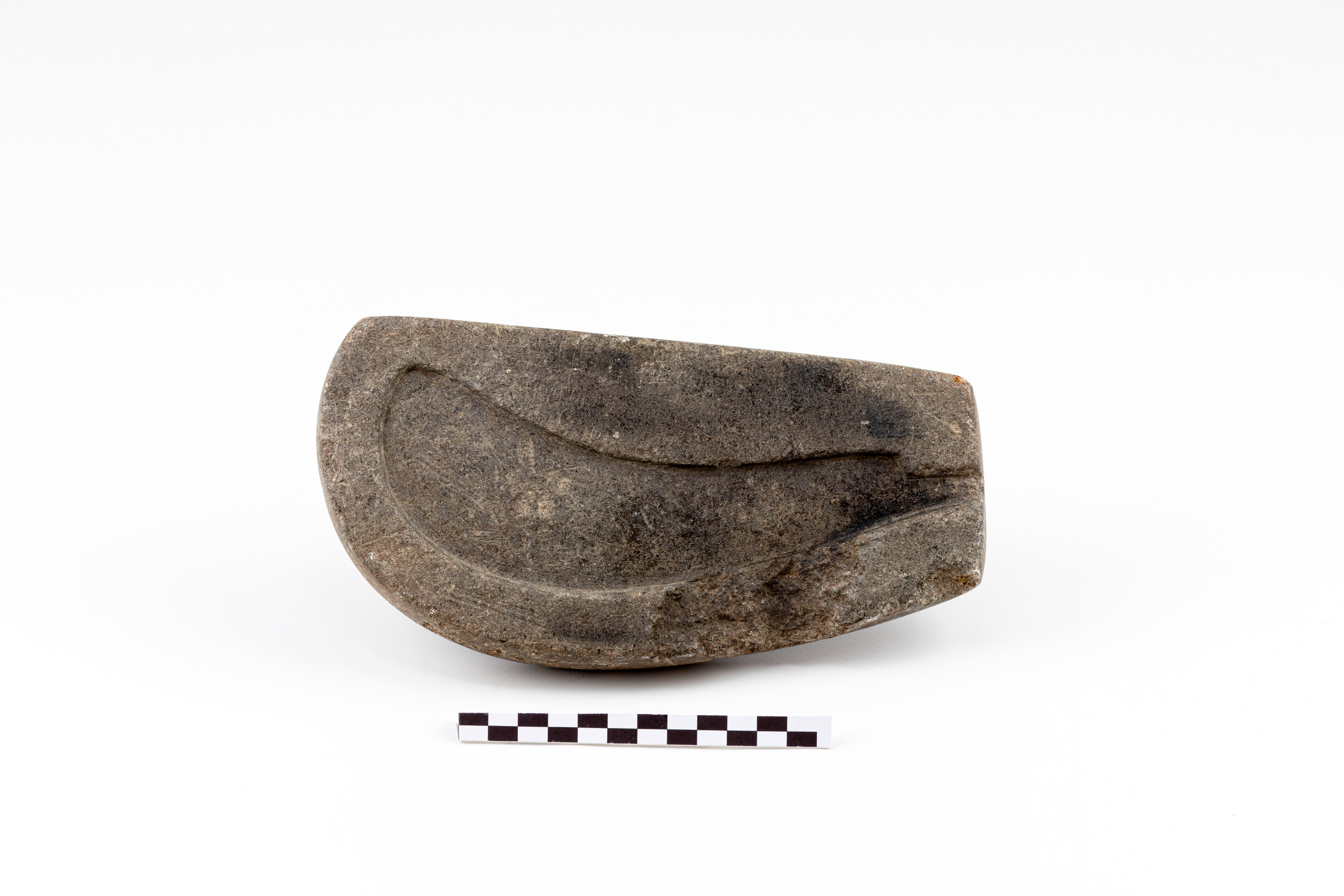
Sickle Casting Mould
Timber-grave culture. Dnipro Forest-Steppe Left Bank Ukraine. The Bronze Age.
The mould consists of a single half with a negative impression of the intended object. The inner surface preserves the outline of a sickle blade and a sprue channel. It was used for casting bronze sickles.
Moulds of this type were an important element of metallurgical production during the Bronze Age and Early Iron Age. They were used for the serial production of agricultural tools, reflecting the development of craftsmanship, advances in metalworking technologies, and the growing needs of agricultural communities. Sickles were among the principal harvesting tools and played an important role in the economic life of ancient communities.
The casting process involved pouring molten metal through the sprue opening into the mould cavity. After cooling, the casting was removed, cleaned of residual sprue material, and subjected to further mechanical finishing. Repeated use of the mould left traces of thermal exposure, abrasion, and localized damage on its surface.
Provenance: Donated to the museum by K. M. Skarzhynska in 1906. Found in Berezniaky Village, Reshetylivka District, in 1810.
Passport of exhibit
- Inventory marks: ПКМВК 29 А 29
- Author (manufacturer): Timber-grave culture
- Material: Magnesian slate
- Technique: Carving, Polishing, Chiselling
- Dating: The Bronze Age
- Size: Length 16 см